
Leading People in an Age of Fracture: Why Connection Is the Last Advantage
There is a crisis unfolding inside modern organisations. It is not driven by technology alone, nor by economics, nor even by politics, but by the convergence of all three, pressing directly onto people and, most acutely, onto people leaders.
Eighty-two percent of those responsible for managing people are doing so accidentally. They were promoted (usually) for their technical excellence or tenure (rather than their leadership capability) and are expected to navigate human complexity with little or no formal preparation. In more stable times, this was mostly manageable. Today, it is combustible.
We are living through an era defined by volatility and division. Geopolitical tensions, economic uncertainty, and the persistent pressure of the cost-of-living crisis are not abstract forces. They shape how people feel. Feelings of anxiety, fear, confusion, panic, division and financial strain don’t stop at the office door, they travel with people. They influence human behaviour, perception, and conflict.
At the same time, the workplace itself has never been more complex. Five generations now work side by side, each with distinct expectations, communication styles, and values; and each carrying their own views and opinions about the others. Cultural diversity has expanded in meaningful and powerful ways, but it also introduces significant nuance that requires skill to navigate. What was once a relatively homogeneous environment is now a rich, but intricate, human ecosystem.
Layer onto this the most significant shift in employment law in a generation. The Employment Rights Act is reshaping an already complex legal landscape, increasing both employer obligations and employee awareness of their rights (albeit, as is often the case, a little knowledge can be a dangerous thing). The margin for leadership error is shrinking, while the consequences of missteps are growing. Managers and leaders are, in my experience, frequently frozen in consequence.
And then there is AI.
Artificial intelligence is not just transforming how work gets done and putting jobs at risk, it is reshaping how people interpret and act on workplace experiences. It amplifies concerns, accelerates communication, and, in frequently more cases, enables the rapid construction of formal grievances and claims that might once have been resolved through a genuinely curious and candid conversation. AI can sharpen narratives, but not always truth. It can escalate issues, but only infrequently resolve them; and if the person prompting AI is carrying the proverbial weight of this divisive era on their shoulders, an escalating output is inevitable.
The result is a system under strain. The UK employment tribunal system is already struggling under the weight of claims. ACAS, long (arguably) a stabilising force in dispute resolution, is similarly stretched. Workplace conflict is not only increasing; it is becoming more complex, more formalised, and more difficult to unwind.
At the same time, the macro picture is sobering. Productivity in both the UK and globally has stagnated. Employee engagement remains persistently and concerningly (but perhaps not surprisingly) low. Organisations are investing in technology, restructuring, and strategy, yet the human engine that ultimately drives performance and success is faltering.
It is not difficult to see why.
We have created an environment in which connection, the fundamental human mechanism through which trust is built, conflict is resolved, and performance is unlocked, is being steadily eroded. Communication is faster, but thinner. Interactions are more frequent, but less meaningful. Misunderstanding travels quickly. Understanding takes time – something which we seemingly have much less of.
In the middle of all this stands, accidentally, a leader.
They are expected to interpret shifting legal frameworks, lead increasingly diverse teams, manage heightened emotional and psychological pressures, and navigate conflicts that can escalate rapidly and formally. They are asked to deliver exceptional performance in a low-productivity, low-engagement environment, while often lacking the training, support, or confidence to do so. This is not a failure of individuals. It is a failure of systems.
Yet within this challenge lies a profound opportunity. Workplaces can become something different. In a world characterised by fragmentation, they can be places of coherence. In a climate of anxiety, they can offer stability. In an environment of division, they can offer connection.
They can – and perhaps must – become a port in the storm.
Doing so, however, requires a fundamental shift in how we think about management and leadership. It demands that we move beyond viewing management as a set of processes or compliance obligations, and instead recognise it as a deeply human practice.
Adam Livingston captures this shift with precision:
“The only remaining moat in working life is authenticity that cannot be cloned, copied, or compressed – qualities that remain inherently scarce even in a world of synthetic abundance: trust, discernment, wisdom, accountability, and genuine connection.”
These are not “soft” skills. They are the infrastructure of effective organisations.
Trust reduces friction. Discernment prevents escalation. Wisdom guides judgment in ambiguity. Accountability creates clarity.
Genuine connection is the enabler of all of these things, but it doesn’t emerge by accident. It is the product of consistent, visible leadership and management behaviour. Behaviours that have to be learned and practiced, often under pressure and in moments that matter:
Communication. Candour. Courage. Curiosity.
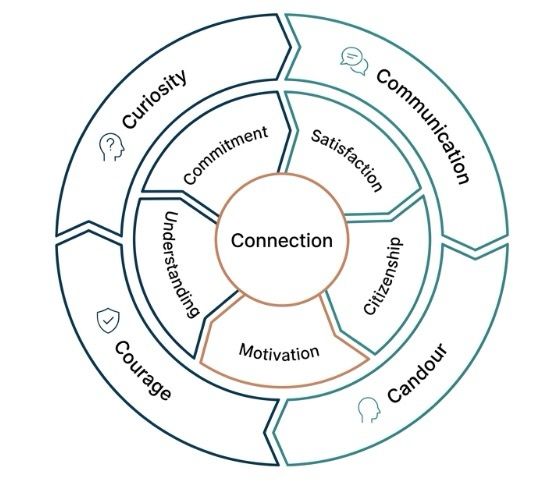
Communication is the foundation. Not just the transmission of information, but actively listening with a focus on creating shared understanding. Clear, timely, and human. In environments where ambiguity is high, silence and inconsistency are the things that breed mistrust quickly.
Candour builds credibility. A willingness to be honest, to address issues directly, and to say what needs to be said respectfully but clearly prevents small tensions from becoming formal disputes. I think of candour as being kind, specific truth. Done well, it shows that you really care.
Courage is what turns intent into action. It is the courage to have difficult conversations early, to make decisions in uncertainty, and, most critically, the courage to be vulnerable. In the inimitable words of Brené Brown: “Vulnerability is not winning or losing; it’s having the courage to show up when you can’t control the outcome.” Leaders who can acknowledge what they do not know, or where they have fallen short, create space for others to do the same.
Curiosity keeps judgment in check. It is the discipline of seeking to understand before concluding, involving asking questions, exploring perspectives, and resisting the instinct to assume. In diverse, multi-generational workplaces, curiosity can’t be optional; it is essential.
When these behaviours are practised consistently and seen clearly by others, they compound. They create trust. They sharpen discernment. They reinforce accountability. They build the kind of genuine connection that technology cannot replicate and policy cannot mandate.
For the accidental manager, learning and practicing these behaviours is where the opportunity lies; not in mastering every complexity of law, technology, or organisational design, but in developing the behavioural capability to navigate them with humanity and clarity.
For organisations that means that developing leadership and management capacity for authentic human connection is not optional. It must be a conscious, strategic necessity. Organisations that invest in this capability will not only reduce risk in an increasingly complex legal and social environment but will also unlock performance in ways that technology alone cannot deliver. It also means redefining success. Not just in terms of outputs and metrics, but in the quality of relationships and the strength of team dynamics.
The future of work will not be determined solely by AI, regulation, geo-politics or economics. It will be shaped by how effectively we enable people to work with, understand, and support one another in an increasingly complex world. The organisations that recognise this, and act on it, will not just survive the current moment. They will lead it.